Purchasing Power of the Median Paycheck
+1.3%
How much more (or less) the typical paycheck buys compared to last year.
Clear, household-centered metrics that cut through the noise to show what matters for everyday American families.

How much more (or less) the typical paycheck buys compared to last year.
How fast prices are rising for things families cannot avoid: housing, food, energy, healthcare.
Share of households that could cover a $400 emergency without borrowing.
How optimistic or pessimistic Americans feel about the economy.
The Sahm Rule is not currently signaling a recession.
What share of household income goes to paying debts.
Dive deeper into each metric to see the full picture of household economic health.
Year-over-year change
This metric tracks how median take-home wages have changed after adjusting for inflation. It shows whether typical paychecks are gaining or losing real purchasing power.
While GDP and stock markets may rise, this metric shows whether ordinary workers are actually better off. It focuses on the median (middle) worker, not averages that can be skewed by high earners.
This does not capture high-income households. GDP can rise even if this falls, because GDP includes corporate profits and investment gains.
Year-over-year change
This metric compares inflation on essential goods (housing, food at home, energy, transportation, healthcare) against headline CPI. It shows the gap between official inflation and what families actually feel.
Official inflation measures include things like electronics and entertainment that people can delay buying. This focuses on unavoidable expenses that consume most household budgets.
This is not the official inflation rate. It specifically tracks necessities, which often rise faster than overall inflation.
Year-over-year change
In 2024, 63% of adults said they could cover a $400 emergency expense with cash or equivalent. 13% said they could not cover such an expense at all. Only 55% have emergency savings covering at least three months of expenses.
Financial resilience determines whether a car repair or medical bill becomes a crisis. This metric shows how many families are one unexpected expense away from financial hardship.
This measures liquid savings available for emergencies, not total wealth or retirement savings.
Year-over-year change
The University of Michigan Consumer Sentiment Index measures how confident people feel about their personal finances and the broader economy. It surveys households about current conditions and expectations for the future.
Consumer sentiment drives spending decisions. When people feel pessimistic, they cut back on purchases, which can slow the economy. It often predicts economic turning points before they show up in other data.
This measures feelings, not facts. Sentiment can diverge from actual economic conditions due to media coverage, political views, or recent experiences.
Year-over-year change
The Sahm Rule triggers when the 3-month average unemployment rate rises 0.5 percentage points above its low from the prior 12 months. Created by economist Claudia Sahm, it has accurately identified every U.S. recession since 1970.
This is an early warning signal. Unlike GDP (which is reported with a lag), the Sahm Rule uses real-time unemployment data to detect recessions as they begin, not months later.
A trigger does not guarantee a deep recession. It signals that labor market conditions are deteriorating in a way historically consistent with recessions.
Year-over-year change
The Household Debt Service Ratio shows the percentage of disposable income that goes toward mortgage and consumer debt payments. It indicates how stretched household budgets are by debt obligations.
High debt burdens leave families vulnerable to income shocks. If job loss or unexpected expenses hit, there is less room in the budget to absorb them. Rising debt service ratios can also constrain consumer spending.
This measures required debt payments, not total debt. Low interest rates can reduce debt service even as total debt rises. It also excludes rent, which is a major expense for non-homeowners.
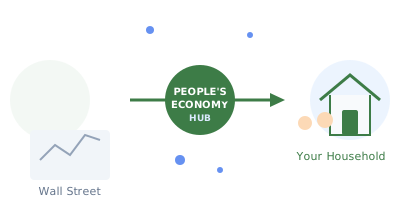
Traditional economic indicators like GDP and stock market indices can rise while typical households struggle.
We focus on metrics that reflect what families actually experience: whether paychecks buy more or less, how much essential costs are rising, and whether people have a financial safety net.
Learn About Our MethodologyAll metrics are derived from official government statistics